
Last Updated: November 16, 2026
Quick Summary
Preventative plumbing maintenance for business is a documented program of scheduled inspections, testing and servicing that catches leaks, blockages and compliance issues before they cause failures. It trades a predictable, budgeted service cost for unpredictable emergency bills, lost trading hours and water damage remediation.
- A commercial plumbing inspection maps every water, waste and gas component on site, scored by condition and risk.
- Cafés and restaurants should run monthly visual checks and quarterly full inspections, focusing on grease traps and drainage.
- Build your plan in five steps: audit the system, rank by risk, set the schedule, assign responsibility and budget for it.
- Budget in three lines: routine servicing, planned replacements and a smaller contingency reserve.
- Choose a contractor on licence, insurance, response capability and record-keeping, not on the lowest quote.
Table of Contents
- Why Preventative Plumbing Maintenance Pays Off for Business
- What a Commercial Plumbing Inspection Covers
- Building Your Commercial Plumbing Maintenance Checklist
- Setting a Commercial Plumbing Maintenance Schedule That Fits Your Site
- How to Build a Commercial Plumbing Maintenance Plan
- The ROI of Preventative Plumbing Maintenance
- Water Efficiency, IoT Sensors and the Future of Plumbing Maintenance
- What to Look for in a Commercial Plumbing Contractor
- Book a Commercial Plumbing Audit for Your Property
- Frequently Asked Questions
Why Preventative Plumbing Maintenance Pays Off for Business
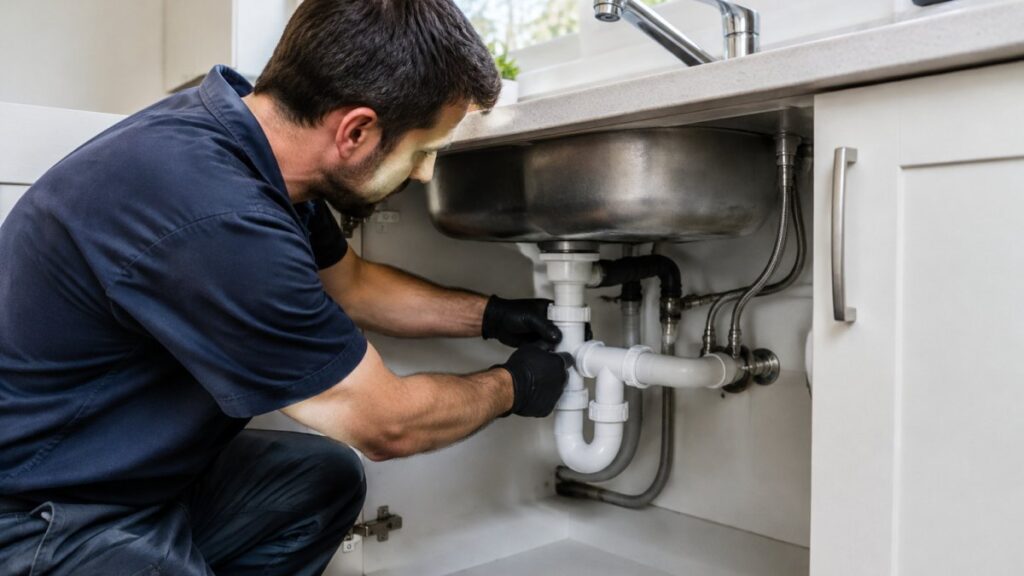
A burst flexi-hose under a café sink at 6am costs far more than the hose itself. It closes the kitchen, ruins stock, buckles flooring and puts staff on mopping duty instead of serving. Preventative plumbing maintenance for business exists to stop that morning from ever happening, and this guide sets out how to build a program that actually holds up.
The real cost of a plumbing failure is rarely the plumbing. It is the lost trading hours, the water-damaged fit-out, the insurance paperwork and the disruption to tenants or customers. A failed hot water system in a 40-unit building means emergency call-outs and complaints to the committee. A blocked grease line in a restaurant means a shutdown while the drain is cleared.
Most businesses only think about their plumbing when something breaks. That is the expensive way to run a building.
What a Commercial Plumbing Inspection Covers
A commercial plumbing inspection is a documented assessment of every water, waste and gas component on site, scored by condition and risk. It covers more than a quick look under the sink. A proper inspection maps the whole system so you know what is healthy, what is ageing and what needs attention before it fails.
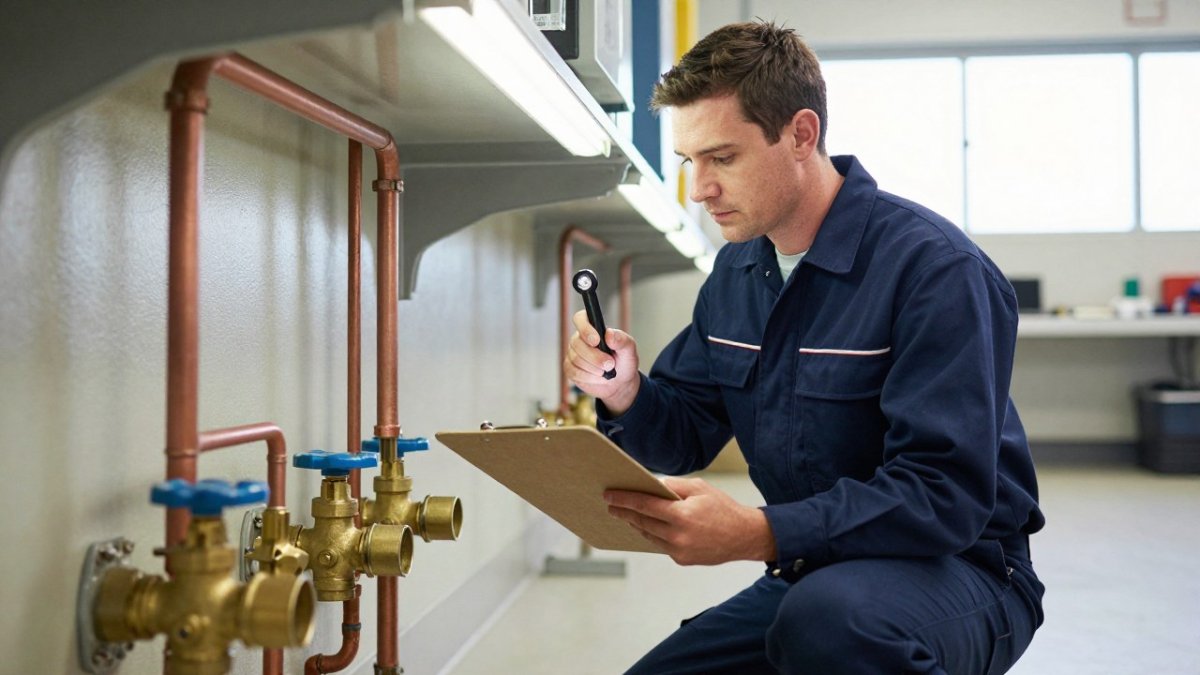
Backflow prevention and thermostatic mixing valves
Two components deserve special attention because they carry compliance weight. Backflow prevention devices stop contaminated water from siphoning back into the mains supply, and they require periodic testing to remain compliant (Backflow devices). Thermostatic mixing valves regulate hot water to a safe delivery temperature at outlets, which matters for staff, customers and anyone using amenities.
Building Your Commercial Plumbing Maintenance Checklist
A commercial plumbing maintenance checklist turns good intentions into a repeatable routine. The best checklists are short enough that someone actually completes them and specific enough to catch real problems. Here is the one we would start with:
- Check all visible pipework and joints for leaks, corrosion or damp patches
- Test backflow prevention devices and record results
- Check thermostatic mixing valve outlet temperatures
- Inspect taps, toilets and fixtures for drips and running cisterns
- Clear and test floor wastes and drainage points
- Check grease traps and waste systems, and schedule drain cleaning
- Inspect the hot water system for pressure, temperature and anode wear
- Check water pressure at key outlets
- Look for signs of leaks behind walls and under floors
- Review service intervals and update the maintenance log
Setting a Commercial Plumbing Maintenance Schedule That Fits Your Site
A commercial plumbing maintenance schedule is the calendar behind the checklist, and it should match how hard your site works. A busy café, a warehouse and a strata building do not share the same wear patterns, so a single generic schedule serves none of them well.
| Property Type | Visual Checks | Full Inspection | Priority Focus |
|---|---|---|---|
| Café or restaurant | Monthly | Quarterly | Grease traps, drainage, hot water |
| Office or retail | Monthly | Six-monthly | Fixtures, backflow devices, leaks |
| Strata building | Monthly | Six-monthly | Common areas, valves, pressure |
| Warehouse or industrial | Monthly | Quarterly | Pipe integrity, waste systems |
Set service intervals based on occupancy, water usage and the age of the system. Newer buildings can often run longer intervals; older plumbing with mixed materials needs closer watching. Review the schedule each year and adjust it as the site changes.
How to Build a Commercial Plumbing Maintenance Plan
A commercial plumbing maintenance plan is the document that ties everything together: the asset list, the checklist, the schedule, the responsible people and the budget. Build it in five steps.
- Audit the system. Have a plumber map every fixture, valve, device and drain on site and record its age and condition.
- Rank by risk. Flag the components where failure would stop trading or breach compliance.
- Set the schedule. Assign service intervals to each asset, from monthly visual checks to annual compliance testing.
- Assign responsibility. Name who completes checks, who books the plumber and who holds the records.
- Budget for it. Allocate a maintenance line item so repairs are planned rather than emergency spending.
Watch out: a plan that lives in a drawer is worthless. If no one owns the log and no one books the service, you have written a document, not a program. Tie the plan to a calendar reminder and a named person.
The ROI of Preventative Plumbing Maintenance
The return on preventative plumbing maintenance comes from avoided costs, not from plumbing savings. You are not spending money to make pipes last longer for their own sake. You are spending a predictable amount to avoid unpredictable, larger bills. The mistake most businesses make is comparing the cost of a service visit against the cost of doing nothing, when the real comparison is a planned service against the fully loaded cost of a failure.
What a failure actually costs
A failure bill has several layers, and the plumbing repair is usually the smallest. Work through them in order:
- Emergency call-out. After-hours rates apply, and the plumber may need to return with parts.
- Water damage remediation. Drying, flooring, cabinetry, ceilings and repainting. This is often the largest line and the one insurance assesses most closely.
- Lost trading. A closed kitchen or a shut retail floor loses revenue that never comes back.
- Stock and fit-out loss. Spoiled food, damaged equipment and ruined fixtures.
- Insurance excess and premium impact. A claim carries an excess, and repeated claims affect future premiums.
- Admin time. Quotes, assessors, paperwork and committee or landlord communication.
A planned service costs a fraction of that total, and it is budgeted. That is the whole argument: you are trading an unpredictable large number for a predictable small one.
Budgeting for it: a lifecycle approach
A useful way to frame the spend is lifecycle cost. Every plumbing asset has an expected service life, and maintenance decisions either extend it or shorten it. A hot water system that is serviced, descaled and has its anode checked at the right intervals will typically outlast one that is left alone, and it will fail less often along the way. The same logic applies to pumps, valves and drainage.
Most practitioners find a simple split works well for budgeting:
- Routine servicing. A fixed annual or quarterly line item for inspections, testing and scheduled maintenance. This is the predictable base.
- Planned replacements. A sinking fund for assets approaching end of life, so a replacement is a budgeted event rather than an emergency.
- Contingency. A smaller reserve for the genuinely unexpected. If the first two lines are funded properly, this one stays small.
A common pattern is that businesses which fund routine servicing and planned replacements spend less overall than those that only ever pay contingency. The contingency line grows when nothing else is planned.
The risk mitigation half
Risk mitigation is the other side of the return. A maintenance log demonstrates diligence, which matters for insurance and for compliance with plumbing regulations. When an assessor or a regulator asks what you have done, the log is the answer. That record is worth having before you need it, not after.
Watch out: a maintenance budget that is set once and never reviewed drifts out of step with the site. Review the split each year against the asset list and adjust it as equipment ages and occupancy changes.
Water Efficiency, IoT Sensors and the Future of Plumbing Maintenance
Water efficiency and digital monitoring are reshaping how commercial plumbing maintenance works, and most guides stop at mentioning them. This section sets out what the technology actually does, where it pays off and how to adopt it without overcommitting.
Water-saving retrofits that pay back
The cheapest efficiency gains are usually retrofits to fixtures and controls you already own:
- Low-flow tapware and aerators. Reduce flow at hand basins and staff amenities without changing the user experience.
- Dual-flush or efficient cisterns. Cut water use in toilets, which are often the largest single water user in an office or retail site.
- Urinal controls and sensors. Prevent continuous flushing in amenities that are not constantly in use.
- Pressure reduction. Excess pressure wastes water and stresses joints; a pressure-reducing valve at the right point protects the system and reduces consumption.
- Hot water efficiency. Descaling, insulation on exposed pipework and correct thermostat settings reduce the energy needed to deliver the same hot water.
These measures reduce both water and energy waste, and a well-maintained system runs more efficiently. Efficiency is both an environmental and a cost outcome, which is why it belongs in the maintenance plan rather than in a separate sustainability project.
What IoT leak detection actually does
Smart sensors and leak detection systems work by watching for abnormal behaviour rather than waiting for a visible puddle. Typical mechanisms include:
- Flow monitoring. A sensor on the main supply learns normal usage patterns and flags continuous flow at times when the site should be quiet, which often indicates a hidden leak.
- Point leak sensors. Small devices placed under sinks, near hot water systems and in plant rooms that alert when moisture is detected.
- Pressure and temperature monitoring. Flags drops or spikes that precede failures.
- Automated shut-off valves. Close the supply when a leak is detected, limiting damage before anyone arrives.
The value is early warning. For a strata building or a multi-site business, that warning is the difference between a small repair and a major claim, and the data feeds straight into your maintenance log.
How to adopt it without overcommitting
You do not need to automate everything at once. A sensible path is:
- Start with the highest-risk assets. Plant rooms, hot water systems and areas above sensitive spaces are the first candidates.
- Add flow monitoring at the main. It gives the broadest coverage for the least hardware.
- Layer point sensors where a failure would hurt most. Under sinks in tenanted areas, near ageing pipework.
- Connect alerts to a named person. A sensor that alerts nobody is just a battery going flat.
- Feed the data into the maintenance log. Trends over time are what justify the next round of investment.
Watch out: monitoring is not a substitute for inspection. Sensors catch the failures they are positioned to catch, and they do not assess corrosion, valve condition or drainage. Use them to sharpen the schedule, not to replace it.
What to Look for in a Commercial Plumbing Contractor
Choose a contractor on licence, insurance, response capability and record-keeping, not on the lowest quote. A commercial plumber needs to handle everything from a routine inspection to an emergency repair, and to document the work so your compliance records stand up.
Ask these questions before you engage anyone:
- Are your plumbers fully licensed and are gas fitters certified?
- Can you show licence numbers before work starts?
- What is your realistic response time for an after-hours emergency?
- How do you diagnose the root cause before quoting a repair?
- Is your pricing transparent, and will the quote match the invoice?
- Can you manage ongoing maintenance across a multi-unit property and handle the committee paperwork?
- Do you provide a written maintenance log and inspection report?
A common mistake is choosing on price alone and then paying twice when the first fix does not hold. What most quotes miss is the diagnostic step: a valve replacement that does not fix the underlying pressure problem is money wasted. Ask how the contractor finds the real cause.
At Greenaway Plumbing, our plumbers are fully licensed and our gas fitters are certified, and we provide honest assessments rather than corner-cutting fixes. We have operated for 20 years across the Eastern Suburbs, and we are available 24/7 for emergencies.
Book a Commercial Plumbing Audit for Your Property
The gap between a well-maintained building and an expensive emergency is usually a plan nobody built. A commercial plumbing audit gives you the asset list, the risk ranking and the schedule in one document, so you can budget for maintenance instead of reacting to failures.
Greenaway Plumbing can walk your property and help you put a preventative maintenance plan in place, backed by fully licensed plumbers, certified gas fitters and 20 years of experience.
A failed valve or a blocked drain never announces itself at a convenient time. The fix is a documented plan, a schedule you actually follow and a licensed team you trust to show up. Greenaway Plumbing offers 24/7 emergency response, fully licensed plumbers and certified gas fitters, and honest assessments across the Eastern Suburbs. Get started with Greenaway Plumbing and book your commercial plumbing audit today.
Frequently Asked Questions
What does preventative plumbing maintenance include for a business?
It covers scheduled inspections of pipework, drains and waste systems, hot water systems, backflow prevention devices, thermostatic mixing valves and fixtures. Plumbers check water pressure, look for leaks and corrosion, test compliance devices and clear or descale drains before blockages form. The aim is to catch wear early, keep the property compliant with plumbing standards and avoid emergency repairs during trading hours. A written report after each visit lets you track asset condition over time and plan budgets.
How often should commercial plumbing be inspected?
Most commercial sites benefit from a full inspection once or twice a year, with high-use venues such as cafes and restaurants checked quarterly. Backflow prevention devices typically need annual testing to stay compliant, and thermostatic mixing valves should be checked at least yearly. Busy kitchens, multi-unit strata buildings and sites with older pipework may need shorter service intervals. Your commercial plumbing maintenance schedule should reflect how hard the system works, not a one-size-fits-all calendar.
How can businesses prevent blocked drains and sewer problems?
Regular drain cleaning and descaling stops grease, scale and debris building up to the point of blockage. Kitchens need grease traps serviced on a set schedule, and all sites benefit from strainers, staff training on what not to flush, and periodic CCTV inspection of sewer lines. A commercial plumbing maintenance plan that includes drain checks catches slow-flowing waste systems before they back up, which is far cheaper than after-hours emergency repairs and lost trading time.
What are the signs that a commercial plumbing system needs maintenance?
Watch for rising water bills, slow drains, discoloured water, damp patches, unusual noises in pipes, fluctuating water pressure and hot water that runs out faster than it used to. Repeated minor leaks or a toilet that keeps running also signal wear. Any of these warrant a commercial plumbing inspection before the problem escalates. Early leak detection and pipe integrity checks usually cost far less than repairing water damage or replacing failed infrastructure.
How do you create a plumbing maintenance schedule for a commercial property?
Start with a plumbing audit that maps every asset: incoming mains, hot water systems, backflow devices, valves, drains and fixtures. Note each item’s condition and any compliance testing due dates. Then set service intervals based on usage and manufacturer guidance, and book visits in advance so they do not clash with trading hours. A documented commercial plumbing maintenance schedule with clear responsibilities makes it easier to brief staff, manage strata committees and budget for upcoming work.


